
Mechanical functions of titanium and titanium alloy processing
author: Hansheng Automation
2023-05-22
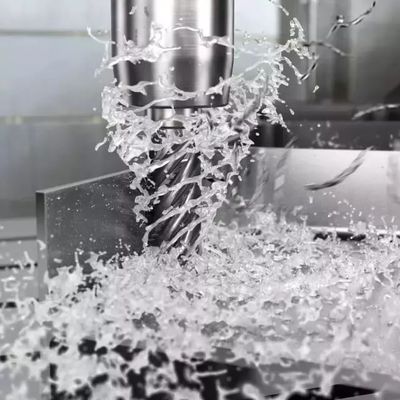
The tensile strength of pure titanium is 265-353MPa, while that of titanium alloys is generally 686-1176MPa. Currently, the highest tensile strength can reach 1764MPa. Titanium alloys have similar strength to many steels, but much better than strength titanium alloys. The specific strength here refers to the strength of the data divided by its apparent density, also known as the strength to weight ratio. The international unit of specific strength is (N/m2)/(kg/m3) or N · m/kg. The ratio of the tensile strength of the data to the apparent density of the data is called the specific strength. The ratio of strength to density at the cracking point of the data.
The compression strength of titanium and titanium alloys shall not be lower than their tensile strength. The compression yield strength and tensile yield strength of industrial pure titanium are roughly the same, while the compression strength of Ti-6Al-4V and Ti-5Al-2.5Sn alloys is slightly higher than the tensile strength. The shear strength is generally 60% - 70% of the tensile strength. The bearing yield strength of titanium and titanium alloy sheet is 1.2-2.0 times of the tensile strength.
Under normal atmospheric conditions, the durability strength of processed and annealed titanium and titanium alloys is (0.5-0.65) times the tensile strength. When conducting 107 fatigue tests in the notch condition (Kt=3.9), the durability strength of annealed Ti-6Al-4V is 0.2 times the tensile strength.
The hardness of high-purity grade processed industrial pure titanium is usually less than 120HB, while the hardness of other purity processed titanium is 200-295HB. The hardness of pure titanium castings is 200-220HB. The hardness value of titanium alloy under annealing condition is 32-38HRC, equivalent to 298-349HB. The hardness of the cast Ti-5Al-2.5Sn and Ti-6Al-4V alloys is 320HB, while the hardness of the low porosity impurity Ti-6Al-4V castings is 310HB.
The tensile elastic modulus of industrial pure titanium is 105-109GPa, and most titanium alloys have a tensile elastic modulus of 110-120GPa under return conditions. Age hardened titanium alloys have slightly higher tensile modulus of elasticity than those under annealing conditions, with compressive modulus of elasticity equal to or greater than tensile modulus of elasticity. Although the stiffness of titanium and titanium alloys is much higher than that of aluminum and aluminum alloys, it is only 55% of that of iron. The specific elastic modulus of titanium alloy is equivalent to that of aluminum alloy, second only to beryllium, molybdenum, and some high-temperature alloys.
The torsional or shear modulus of industrial pure titanium is 46GPa, and the shear modulus of titanium alloy is 43-51GPa.
Adding interstitial element content to improve the strength of titanium alloys can have harmful effects on their impact resistance and cracking toughness. According to the types and conditions of titanium alloys, the Charpy notch impact strength value of processed industrial pure titanium is 15-54J/cm2, and that of cast titanium is 4-10J/cm2. The impact strength of titanium alloy under annealing condition is 13-25.8J/cm2, and the aging condition is slightly lower. The Charpy V-notch impact strength of Ti-5Al-2.5Sn alloy in casting condition is 10J/cm2, while that of Ti-6Al-4V alloy is 20-23J/cm2. The lower the oxygen content of titanium alloy processing materials, the higher this value.
Many titanium alloys have high cracking toughness, or rather, their ability to resist crack propagation is excellent. Annealed Ti-6Al-4V alloy is a type of material with excellent resistance. When the notch concentration coefficient Kt=25.4mm, the ratio of notch tensile strength to non notch tensile strength is greater than 1.
Titanium alloys can still maintain certain functions at high temperatures. General industrial titanium alloys can maintain their useful functions at a temperature of 540 ℃, but can only be used for short periods of time, with a temperature range of 450-480 ℃ for long-term use. A titanium alloy has been developed for use at a temperature of 600 ℃. Titanium alloy can be used as missile material for long-term use at a temperature of 540 ℃ and for short-term use at a temperature of 760 ℃.
Titanium and titanium alloy materials can still maintain their original mechanical functions at low and ultra-low temperatures. As the temperature decreases, the strength of titanium and titanium alloy materials continues to increase, while the ductility gradually deteriorates. Many annealed titanium alloy materials still have sufficient ductility and cracking toughness at temperatures of -195.5 ℃. Ti-5Al-2.5Sn alloy with very few interstitial elements can be used at a temperature of -252.7 ℃. The ratio of its notch tensile strength to non notch tensile strength is 0.95-1.15 at -25.7 ℃.
Liquid oxygen, liquid hydrogen, and liquid fluorine are important propellants in missiles and world equipment. The low-temperature function of materials used for manufacturing low-temperature gas containers and low-temperature structural components is very important. When the microstructure is equiaxed and the content of interstitial elements (oxygen, nitrogen, hydrogen, etc.) is very low, the ductility of titanium alloys is still above 5%. Most titanium alloys have poor ductility at temperatures of -252.7 ℃, while the elongation of Ti-6Al-4V alloy can still reach 12%.
What are the advantages of CNC precision automatic lathe processing in work
Steps and methods for processing non-standard precision parts
Related Article

Let us go over the foundations of the electroplating procedure. Electroplating involves several phases, and from pre-treatment to post-treatment there are several really significant ones.
The basic principle of surface treatment of precision parts in CNC machining

Audio panels, electronic cigarette shells, nameplateLOG, watch shells, etc. are among the CNC processing of high surface texture needs components.
CNC machining aluminum alloy parts high-quality surface texture process explained in detail

Metallic finishing, sometimes known as metallic finishing, is the process of using several techniques to change the surface of an object in order to improve appearance and performance, such as corrosion resistance, discoloration resistance, chemical resistance, abrasion resistance, and hardness, modify electrical conductivity, remove burrs, or apply a specific color to a machined part.
Metal CNC finishing surface treatment process and its working principle
