
Introduce common troubleshooting of CNC machining center cutting cylinder
author: Hansheng Automation
2023-05-06
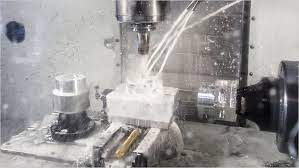
The cutting cylinder is an important accessory in the machining center machine tool, which can achieve automatic or semi-automatic tool exchange mechanism for spindle cutting, and can also serve as a clamping device for fixtures and other mechanisms. The commonly equipped cutting cylinder models are as follows: The 30 # spindle generally uses a 2.0T cutting cylinder. The 40 # spindle usually uses a 3.5T cutting cylinder. The 50 # spindle usually uses a 6T cutting cylinder.
Working principle of the cutting cylinder:
Assembling a cutting cylinder on the spindle of the machining center machine tool can complete the installation and exchange of the tool handle. It is a force boosting air pressure conversion device, which is used for the piston of the cutting cylinder after the action of compressed air to generate thrust. The cutting head is clamped by pulling the cylinder, and during the cutting process, the cutting head is released and cleaned by "blowing" to facilitate tool replacement and achieve the action of the mechanical device.
Common faults of the cutting cylinder during long-term use:
1、 The solenoid valve of the cutting cylinder is leaking
1. Silencer leakage is caused by the wear of the sealing ring inside the valve body or foreign objects inside the valve body, which prevents the piston from returning to its original position. If this situation is found, the inside of the valve body should be cleaned and the sealing ring replaced.
2. Air leakage at the coil is usually caused by a damaged sealing gasket in the valve body or loose valve body screws. In this case, it is necessary to check the valve body fixing screws and replace the sealing gasket in a timely manner.
2、 An "external leakage" fault occurred at the piston rod of the cutting cylinder
1. Check if the guide sleeve and piston rod sealing ring are worn, and if the piston rod is worn excessively. If the above situation occurs, replace the piston rod and sealing ring to improve their lubrication effect.
2. Check the piston rod for any scratches or corrosion. If any scratches or corrosion are found, replace the piston rod.
3. Check if there are any dirt or impurities between the piston rod and the guide sleeve. If there are impurities, remove them and install the dust ring.
3、 When there is an "external leakage" fault in the cylinder block and end cover of the CNC machining center's cutting cylinder
1. Check if the sealing ring is damaged, and if any damage is found, replace the sealing ring in a timely manner.
2. Check if the fixing screws are loose, and if they are loose, tighten the fixing screws.
4、 When a 'stop' fault occurs during the operation of the cutting cylinder in the CNC machining center
1. Check if the load is concentric with the axis of the cutting cylinder. If not, use a floating joint to connect the load.
2. Check if solid pollutants are mixed in the cutting cylinder. If there are any pollutants, clean them up and improve the quality of the air produced by the air source.
3. Check if the sealing ring inside the cutting cylinder is damaged, and replace it if damaged.
4. Check the load guidance condition, and if poor load guidance is found, readjust the load guidance device.
Structure, material, and process analysis of shaft parts processing
What level of accuracy should be achieved for different CNC machining processes in large CNC machining plants
Related Article

Let us go over the foundations of the electroplating procedure. Electroplating involves several phases, and from pre-treatment to post-treatment there are several really significant ones.
The basic principle of surface treatment of precision parts in CNC machining

Audio panels, electronic cigarette shells, nameplateLOG, watch shells, etc. are among the CNC processing of high surface texture needs components.
CNC machining aluminum alloy parts high-quality surface texture process explained in detail

Metallic finishing, sometimes known as metallic finishing, is the process of using several techniques to change the surface of an object in order to improve appearance and performance, such as corrosion resistance, discoloration resistance, chemical resistance, abrasion resistance, and hardness, modify electrical conductivity, remove burrs, or apply a specific color to a machined part.
Metal CNC finishing surface treatment process and its working principle
