
Improvement Measures for Surface Roughness in Precision Parts Processing
author: Hansheng Automation
2023-05-16
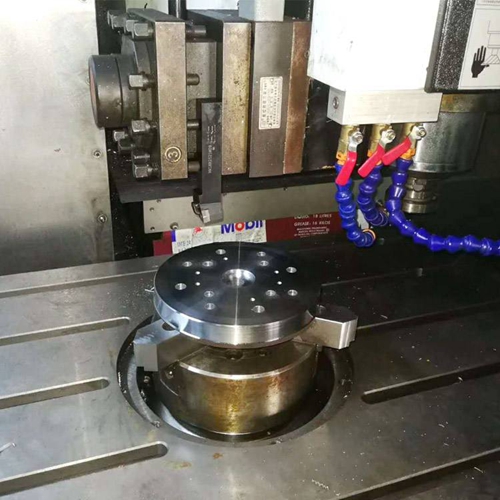
The process factors that affect surface roughness in precision part machining mainly include cutting amount, tool geometric parameters, and so on. To improve, we need to start from these aspects:
1. Cutting amount
The larger the feed rate, the higher the height of the residual area, and the rougher the surface of the part. Therefore, reducing the feed rate can effectively reduce the surface roughness value.
The cutting speed also has a significant impact on surface roughness. When cutting elastic-plastic materials at medium speed, the surface roughness of the processed parts is relatively high due to the tendency to accumulate chips and significant plastic deformation. Usually, low-speed or high-speed cutting of elastic-plastic materials can effectively avoid the formation of chip deposits, which has a positive effect on reducing surface roughness values.
2. Tool geometric parameters
The main deviation angle, secondary deviation angle, and tool tip arc radius have a direct impact on the surface roughness of precision parts processing. Under a certain feed rate, reducing the main and secondary deviation angles or increasing the tool tip arc radius can reduce the surface roughness value. In addition, increasing the rake and rake angles appropriately can reduce cutting deformation and friction between the front and rear cutting surfaces, suppress the generation of accumulated chips, and also reduce surface roughness values.
Process factors and improvement measures affecting surface roughness in precision parts processing
Advantages and Characteristics of Vibration Cutting in Precision Parts Processing
Related Article

Let us go over the foundations of the electroplating procedure. Electroplating involves several phases, and from pre-treatment to post-treatment there are several really significant ones.
The basic principle of surface treatment of precision parts in CNC machining

Audio panels, electronic cigarette shells, nameplateLOG, watch shells, etc. are among the CNC processing of high surface texture needs components.
CNC machining aluminum alloy parts high-quality surface texture process explained in detail

Metallic finishing, sometimes known as metallic finishing, is the process of using several techniques to change the surface of an object in order to improve appearance and performance, such as corrosion resistance, discoloration resistance, chemical resistance, abrasion resistance, and hardness, modify electrical conductivity, remove burrs, or apply a specific color to a machined part.
Metal CNC finishing surface treatment process and its working principle
