
Common Process Equipment for Assembly and Milling in Precision Parts Processing
author: Hansheng Automation
2023-05-17
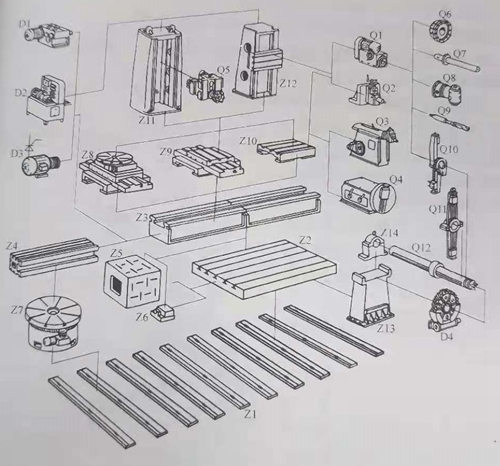
In precision part machining, the process assembly of modular machine tool milling usually includes three parts: cutting components, transmission components, and support components.
(1) The cutting components used for milling require a certain degree of accuracy and stiffness in linear or rotary motion, such as the radial circular runout of the power head spindle, which should generally be less than 0.02~0.03mm; The radial stiffness of the main shaft is generally 100-300N/um, and larger specifications of the main shaft should be taken as the larger value.
(2) The transmission components used for milling processing require small volume, light weight, and suitable cutting speeds or feed rates for various machining processes, such as milling and boring power heads, rotary workbenches, etc. The main cutting power is generally 3-17kW. Due to the low precision of the workpiece and the generally large machining allowance, there should be room for the power of the general motor.
(3) The support components used for milling in precision parts processing should have a certain degree of stiffness and guiding accuracy, and the guiding dimensions should be generalized to facilitate splicing and interchangeability.
Application of Group Technology in Precision Parts Processing
Requirements of Milling Tooth Profile of Roller Chain Wheel for Machining Precision Parts
Related Article

Let us go over the foundations of the electroplating procedure. Electroplating involves several phases, and from pre-treatment to post-treatment there are several really significant ones.
The basic principle of surface treatment of precision parts in CNC machining

Audio panels, electronic cigarette shells, nameplateLOG, watch shells, etc. are among the CNC processing of high surface texture needs components.
CNC machining aluminum alloy parts high-quality surface texture process explained in detail

Metallic finishing, sometimes known as metallic finishing, is the process of using several techniques to change the surface of an object in order to improve appearance and performance, such as corrosion resistance, discoloration resistance, chemical resistance, abrasion resistance, and hardness, modify electrical conductivity, remove burrs, or apply a specific color to a machined part.
Metal CNC finishing surface treatment process and its working principle
