
CNC milling machine

Milling Process - Definition
Milling is a subtractive manufacturing process that uses cutting tools to remove material from a workpiece to form complex geometric patterns. Workpieces, usually fixed on a movable table, are fed into a rotary multi-point machine. While the milling process can be performed by highly skilled technicians on manual milling machines, the process can now be performed on computer-controlled milling machines called computer numerical control (CNC) milling machines. The use of CNC milling machines leads to higher precision and higher productivity.
CNC Milling Process - Overview
Computer Numerical Control Milling, or CNC milling, is the production of desired products with highly accurate and precise dimensions and complex patterns using an automated material removal process mechanically. The rotational motion of the cutting tool and the relative motion of the workpiece material are responsible for transforming the workpiece into the desired geometry.
The entire stage of material processing is similar to other traditional processing processes. A workpiece usually goes through the following stages:
- Prepare the CAD design
- Convert CAD designs to CNC programs
- Setup of a CNC milling machine
- Execution of the milling process
The first step in machining with CNC milling is to create a computer design using CAD software. The design indicates the dimensions and geometry required for the final product. The next step is to convert this CAD file into a program that can be executed by CNC software, i.e., CAM. Once the documentation is ready, CAM controls the movement of the tool and the feed of the workpiece to produce the final product. The setup of the CNC milling machine is completed prior to the CAM execution file, which includes clamping the workpiece onto the table using a vise or other equipment. The tool is fixed on the machine spindle according to the work requirements. Once all the preparations are done, the technician uses the machine interface to issue commands to the CNC milling machine to carry out the milling process.
Depending on the type of CNC mill used and the desired final geometry pattern, the CNC mill performs the material removal process by:
- Feed the workpiece slowly while keeping the rotating tool stationary
- Keep the workpiece still while moving the tool on the workpiece
- By the relative motion between the tool and the workpiece
CNC milling can be performed to create workpieces from stock materials; However, it is often performed as a secondary machining process to perform finishing operations or to create geometric features such as slots or holes in the workpiece. For complex geometric patterns, CNC milling can be performed multiple times with different orientations and settings for the workpiece and tool. After that, the parts are transferred to other facilities to perform other finishing processes.
CNC milling machine - operation
CNC milling machines offer higher accuracy and tolerance constraints; As a result, it is used to machine parts with tolerances between +/- 0.001 and 0.005 inches. Some CNC machines can also achieve tolerances of 0.0005 inches. As a result, the high precision and precision machining performed with CNC milling machines makes it usable for a variety of operations in the industry. Some of these widely performed operations are:
Face milling
Face milling is a machining process that is usually performed on a vertical or horizontal CNC milling machine to produce a flat surface or profile on a workpiece. The process involves rotating the tool, the axis of which is perpendicular to the workpiece. Cutting tools have teeth on the periphery side and on the front. Peripheral cutting tools are used to remove material from the workpiece by cutting, while frontal cutting teeth are used to improve the surface finish of the workpiece.
End milling with an end mill and side milling with a side mill are the two types of face milling.
Face milling
In contrast to face milling, face milling is performed with the tool rotating parallel to the workpiece. The cutting teeth located on the periphery are used to cut the material. Depending on the requirements of the workpiece, the teeth of the cutting tool are changed to obtain the desired cutting effect. For deep cuts, a narrower tool is used, while for larger materials, a wider toothed cutter is used. Similarly, changing the speed of the tool and the feed of the workpiece can result in finer or rough cuts.
Angle milling
Angle milling, or also known as angle milling, is a milling process that is used to produce angular geometric features such as chamfers or dovetails. As the name suggests, angle milling involves the rotation of the cutting tool at an angle relative to the workpiece.
Profile milling
Profile milling is a numerical control milling operation used to produce irregular shapes such as hemispheres or circular profiles. Shaped cutting tools are used for these specific shapes, and these job-specific tools can also machine some common shapes, such as curves or beads, as well as complex patterns.
CNC milling machine - features:
CNC milling machines offer extra features that make them more powerful than traditional milling machines. These characteristics are discussed below:
- Unlike manual milling machines, advanced and complex shapes and geometries can also be machined using CNC milling machines. A high degree of control over dimensions and tolerances can also be achieved with CNC milling.
- CNC machines execute mathematical models that allow them to handle parts that are difficult to machine with traditional or ordinary machine tools.
- Due to the high degree of automation involved in the machining process, the involvement of technicians and operators is reduced. This also minimizes the extent of personal error.
- The use of CNC milling machines to produce parts effectively reduces the production time. The whole process of setting up a CNC machine for operation is very simple. Therefore, changing the position of the workpiece or tool is a time-saving mechanism that does not waste time.
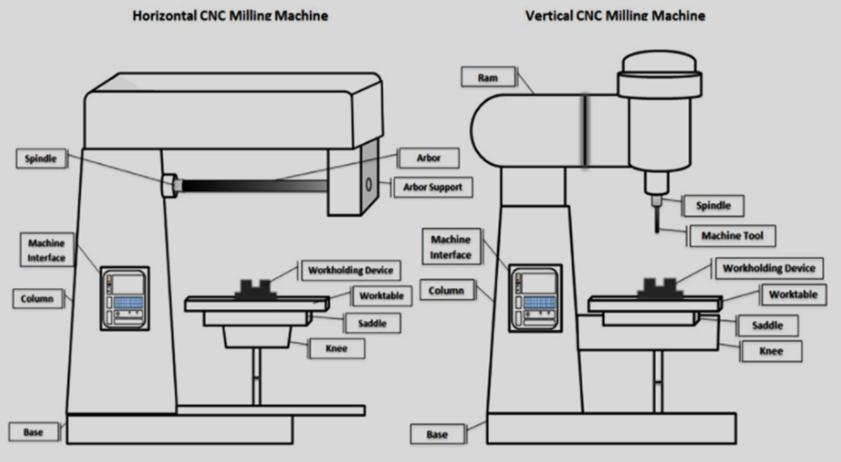
CNC milling machines - components
The structure of CNC milling machines varies depending on the function, but almost all CNC milling machines have the same common components, as follows:
Optimize your CNC design
What you need to know about CNC aluminum machining
Related Article


