
CNC machining of fuel cell metal bipolar plates
The function of the bipolar plate
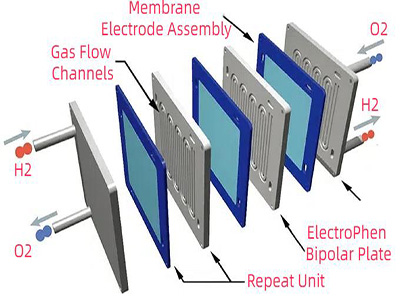
Bipolar plates are used to conduct electric current within the fuel cell stack and are also involved in electrochemical reactions. Here are some of the features of bipolar plates:
Current collection and distribution: It can efficiently collect and distribute current, ensuring that the current is evenly distributed within the fuel cell stack.
Gas & Coolant C-Axis: This plate has gas and coolant channels for supplying the reaction gas and cooling the fuel cell stack.
Structural upport: In addition, it provides structural support to maintain the mechanical integrity of the fuel cell stack.
Thermal management: Good thermal conductivity enables the bipolar plates to easily transfer and dissipate heat, ensuring proper thermal management of the fuel cell stack.
Corrosion resistance: Proper selection of metal materials can guarantee excellent corrosion resistance of bipolar plates in electrochemical environments.
The material of the bipolar plates
There are a variety of materials that can be used to make bipolar plates. Their common materials include:
- Stainless steel: good mechanical properties, corrosion resistance and electrical conductivity. Often
- Titanium: Excellent corrosion resistance, but at a higher cost.
- Aluminum: Relatively low density, good electrical conductivity, but poor corrosion resistance, requiring surface treatment.
- Metal composites: Composed of a metal matrix and ceramic or carbon fiber reinforced materials, combining the advantages of metals and composites.
In general, it requires a combination of factors such as cost, mechanical properties, conductivity, and corrosion resistance when selecting materials that meet the specific requirements of the battery system.
Benefits of CNC machining of fuel cell bipolar plates
CNC machining technology provides an important support for the optimal manufacturing of fuel cell bipolar plates.
High precision: It can achieve high-precision dimensional control and surface finish to meet the strict geometric requirements of fuel cell bipolar plates.
Complex structure e: CNC machining can process complex channel structures and microstructures, improving the fluid distribution and reactivity of bipolar plates.
Material An adaptability: In addition, it can process a variety of metal materials to meet the material requirements.
Mass production capacity: It has good mass production capacity, which can meet the large-scale production needs of fuel cell industrialization.
Flexibility and renewability: The technology allows for rapid adaptation and modification of the design, increasing the iteration speed of fuel cell bipolar plates.
Cost-friendly: In addition, CNC machining can reduce manual operations and increase production efficiency, which can reduce the manufacturing cost of bipolar plates.
Application of CNC machining in bipolar plates
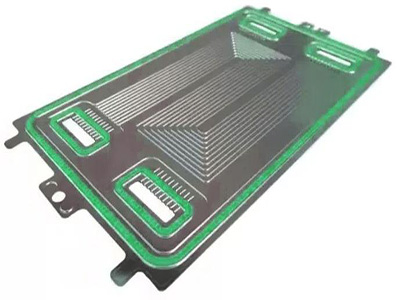
1. Runners
The channel structure on the bipolar helps to direct the flow of reaction gases and coolants. CNC machining allows precise control over the size, shape, and position of the runners. This ensures that the reactive gases are evenly distributed in the channels, thus improving the performance of the bipolar plates. In addition, precision machining enables complex three-dimensional runner structures, from serpentine runners to branch runners.
2. Flakes
This refers to a bipolar plate body, which is usually made of metal or carbon composite sheets. With precision CNC machining, the thickness of the bipolar plates can be reduced to 0.1-0.3 mm, significantly reducing the weight of the stack. In addition, this technology can maintain the flatness and dimensional accuracy of ultra-thin bipolar plates.
3. Bipolar plate integration
Bipolar plate integration involves the integration of components such as flow channels, gas diffusion layers, and catalyst layers into a single bipolar plate structure to achieve integrated manufacturing. However, CNC machining can achieve the precise docking of these parts, guaranteeing the overall performance of the battery pack.
A comprehensive guide to gasket types
A guide to the knurling process
Related Article


