
Basic Overview of Aviation Components in Precision Parts Processing
author: Hansheng Automation
2023-05-11
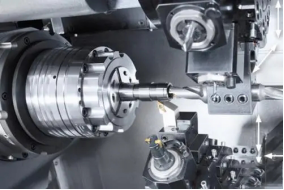
In precision parts processing, aviation components refer to the body components of an aircraft, which constitute the external shape and main force components of the aircraft. There are many types of aviation components, and airplanes are mainly divided into three parts: the airframe, engines, and onboard equipment.
In precision parts processing, the aircraft body refers to the parts that constitute the external shape and main forces of the aircraft, including the fuselage, wings, tail wings, and landing gear, and is widely involved in major components such as doors, beams, stringers, wing beams, wing ribs, and frames. The production and assembly process of aviation components can be divided into four stages: tooling, component manufacturing, sub assembly, and aircraft final assembly. In recent years, as the GDP growth rate gradually slows down, the growth rate of China's defense investment has also gradually stabilized. In recent years, the overall amount of subcontracted delivery of civil aviation components in China has shown a continuous growth trend. In 2019, the scale of subcontracted civil aviation components in China reached 12.3 billion yuan, an increase of 500 million yuan compared to 2018.
What are the characteristics of deep hole honing tools at Dongguan CNC Precision Machining Factory
Participating enterprises of aviation components in precision parts processing
Related Article

Let us go over the foundations of the electroplating procedure. Electroplating involves several phases, and from pre-treatment to post-treatment there are several really significant ones.
The basic principle of surface treatment of precision parts in CNC machining

Audio panels, electronic cigarette shells, nameplateLOG, watch shells, etc. are among the CNC processing of high surface texture needs components.
CNC machining aluminum alloy parts high-quality surface texture process explained in detail

Metallic finishing, sometimes known as metallic finishing, is the process of using several techniques to change the surface of an object in order to improve appearance and performance, such as corrosion resistance, discoloration resistance, chemical resistance, abrasion resistance, and hardness, modify electrical conductivity, remove burrs, or apply a specific color to a machined part.
Metal CNC finishing surface treatment process and its working principle
