
What is aluminum anodizing (anodizing)? Its characteristics, types and uses

Aluminium anodizing (anodizing) is a surface treatment that protects the inherent properties of aluminum. Its application is very wide, it can be said that almost all industrial aluminum products will use it. Let's take a look at the features, advantages, and disadvantages of anodized aluminum.
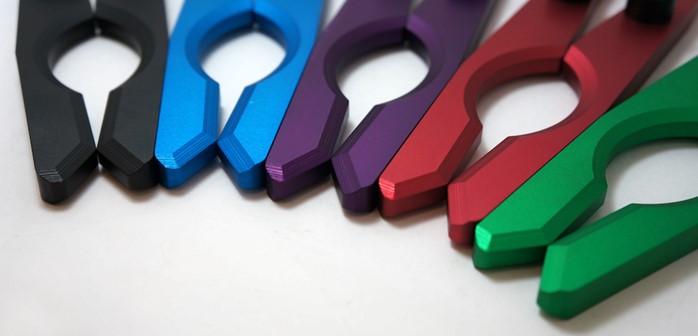
Aluminum anodizing (anodizing) features
Aluminum anodizing is a process in which an oxide film is artificially created on the surface of aluminum.
Generally speaking, aluminum is a metal that does not rust easily, but in fact, aluminum itself has a high tendency to ionize, and it has the property of easily reacting with various chemicals such as water and oxygen. Therefore, after contact with the air, it will combine with the oxygen element in the air to produce a thin oxide film, known as alumina (AL2O3), also known as bauxite, which is characterized by very stable chemical properties. Therefore, it is not only antioxidant, but also resistant to liquid and acid attack, and is not easy to cause other chemical reactions. Therefore, even without special treatment, the oxide film layer on the surface of aluminum has the property of protecting the interior from corrosion. This is why aluminium is considered a non-rusty metal. Therefore, metals that have the property of protecting their interiors through a naturally occurring film on the surface are called inactive. However, this naturally occurring oxide film is only about 2nm, which is very thin, and even a slight scratch will expose the inner substrate. Therefore, it cannot be expected to have a good corrosion protection effect. Therefore, the electrolytic treatment of aluminum artificially produces a thicker oxide film, which is aluminum anodizing. In addition to sulfuric acid and chromic acid, aluminum can also be immersed in acidic aqueous solutions such as phosphoric acid and oxalic acid, and aluminum is placed on the anode (cathode) side for electrolysis, and an oxide film is formed on the surface of the aluminum due to the oxidation reaction that occurs at the anode. So this treatment is also known as aluminum anodizing treatment. Also known as anodizing. The thickness of the oxide film produced by aluminum anodizing is between 5~70μm, and the structure is like a honeycomb, and the center of the hexagonal unit is regularly arranged with small holes. Another characteristic of aluminum anodizing is that the oxidized workpiece consists of a thin film part that increases outward from the surface of the base metal, and a part that penetrates inward from the surface of the base metal. Therefore, when the anodized part is anodized again, the alumina layer must be peeled off once, thereby reducing the thickness of the substrate and making it thinner. Since the secondary anodizing increases the film further outward, the external dimensions of the product also change. For example, in the case of standard white aluminum anodizing, the surface size may increase outwards by about 5 μm after aluminum anodizing, since the film thickness of aluminum anodizing is about 10 μm. It should be noted that in bag holes such as screw holes that have not penetrated, even if they have been degreased beforehand, cutting oil may remain in the holes, and sometimes these solutions will be sprayed out in aluminum anodizing. In bag-shaped holes, such as non-through-threaded holes, cutting oil may remain in the holes, even if they have been degreased beforehand, and in some cases, these solutions may gush out during the anodizing process, so care must be taken.
Types of aluminum anodizing
Depending on the color and surface, aluminum anodizing can be classified into many types. Here are three of the most representative of them.
1.White aluminum anodizing: It is the most common type of aluminum anodizing. It will not appear white, but it will give the substrate a slightly dull appearance. The film thickness is about 10 μm.
2.Black Aluminum Anodizing: Aluminum anodizing is dyed in different colors. The one dyed black is called black aluminum anodizing. It is the most commonly used method of anodizing colored aluminum.
3.Aluminum anodizing (matte): If the material is sandblasted before the aluminum anodizing process, a matte finish will be created. It is particularly highly decorative in aluminum anodizing and can be dyed not only white, but also in a variety of colors.
Advantages of aluminum anodizing:
In addition to preventing corrosion of aluminum, aluminium anodizing has many other advantages.
• No shedding: Aluminum anodizing grows and blends together while eroding the base metal. Therefore, unlike plating and spraying, there is no need to worry about the oxide layer falling off.
• Strong corrosion resistance, discoloration resistance, corrosion resistance: the main component of alumina (AL2O3) is bauxite, which has the characteristics of chemical stability and not easy to react with other chemicals. In addition, by sealing the honeycomb holes formed on the oxide film, it is possible to achieve higher corrosion resistance. This makes it less prone to discoloration and corrosion.
• The oxide film is very hard and wear-resistant: aluminium itself is a relatively soft, easily machined and deformed metal. The surface hardness is only about HV20~150. However, since alumina is a very hard substance, the surface hardness of aluminum after aluminum anodizing can be increased to about HV200-600. Therefore, it has the advantage of being highly resistant to abrasion. In particular, the hardness of hard aluminum anodized materials with a film thickness of more than 20 μm exceeds that of HV400, and the surface hardness can exceed that of stainless steel. Therefore, it can also be used for sliding parts such as shafts.
• It can be colored in a variety of colors and has a beautiful appearance: As mentioned earlier, the film formed by aluminum anodizing has regularly arranged micropores. It adsorbs dyes and can be colored into a variety of colors, which is also one of the advantages of aluminum anodizing. The coloration of aluminum anodizing is achieved by immersing the part in a dissolved colorant solution after electrolysis and before the honeycomb hole sealing treatment. This results in a beautiful surface with a bright metallic sheen that is different from the coating, which is one of its characteristics. In addition, due to the high hardness of aluminum anodizing itself, its beautiful surface is not easily destroyed, which is also its characteristic. Therefore, anodized aluminum products are often used in areas that require a good appearance, such as building exteriors and machine exteriors.
• Strong insulation, non-conductive: The alumina film formed by aluminum anodizing is non-conductive. Aluminum itself has a high electrical conductivity, but after being anodized by aluminum, it is insulating. Conversely, if it is desirable to be electrically conductive, the aluminum anodized layer can be removed by methods such as cutting, so that the base metal is exposed.
• Low thermal conductivity but high heat dissipation: Aluminum anodizing has low thermal conductivity and thermal insulation properties. On the other hand, anodized aluminum is characterized by high radiation (such as far-infrared radiation) and high heat dissipation. For this reason, anodized aluminum is often used as a heat dissipation component such as heat sinks.
Disadvantages of aluminum anodizing
Although aluminum anodizing has many advantages, it also has some drawbacks and issues to be aware of.
• High brittleness, insufficient toughness: Aluminum anodizing forms a very hard film layer. Therefore, aluminum has the disadvantages of insufficient toughness and high fragility after anodizing. If drilled or bent after aluminum anodizing, it can cause the film to crack or the aluminum anodizing layer to peel off from the cracks. Therefore, it is best to complete the processing of other characteristics before the aluminum anodizing treatment, but you need to pay attention to whether the oxide layer is damaged when purchasing the anodized material and processing it.
• Low heat resistance: Because the anodized aluminum layer is brittle, it has the disadvantage that it cannot withstand the deformation and expansion and contraction of the base metal. Especially since the aluminum substrate is a material that is prone to thermal expansion, the anodized aluminum layer may crack and peel off in environments with temperatures above 100°C. Although anodized aluminum itself is a stable and strong film layer, the nature of its base material, aluminum, inevitably affects it. Please note that it is not intended for use in environments with high temperatures or large temperature variations.
The main use of aluminum anodizing
Aluminum anodizing is very versatile. Here are a few representative examples.
• Lunch boxes, kettles, pots and pans and other kitchen items: Aluminum anodized materials that are not easy to corrode, light in weight, and resistant to scratches are ideal for supplies that are frequently exposed to water around the kitchen. Traditional aluminum bento boxes, jars, pots, etc. are all made by aluminum anodizing.
• Home appliance parts such as smartphones: Aluminum anodized materials are widely used in home appliance parts because they have a beautiful appearance and are not easily damaged. Highly decorative, aluminium anodized materials can increase the added value of electronic products, which is why they are widely used.
• Building materials such as window frames: Aluminum anodized materials with high corrosion resistance and high decorative properties are also commonly used in building materials. There are many anodized aluminium products around the building, such as carport columns, metal columns and window frames.
• Interior parts for trains, airplanes, etc.: In order to improve fuel economy and energy saving in transportation equipment, it is necessary to reduce weight. Therefore, aluminum parts products that have been anodized with aluminum are widely used.
• Aluminum alloy wheels and other auto parts: Corrosion-resistant and wear-resistant aluminum anodized material products are also very suitable for automotive wheels.
• Optics: The advantage of aluminum anodizing is that it is highly decorative, and it can be processed into a variety of colors. Black aluminium anodized parts that are not easily reflective are used around the optics
• Semiconductor components: Aluminum anodized products have high insulation and high heat dissipation. For this reason, aluminum anodized materials are also widely used in components around semiconductors in electronic devices.
• LED and other lighting equipment: Lamps and lanterns are the most likely to be highly creative products in electrical products. Aluminum anodized products are not only highly decorative but also have heat dissipation properties, so they are also widely used in lighting fixtures.
• Medical devices: Devices with high hygiene requirements, such as medical devices, must be scratch resistant. This is because dirt accumulates in the scratched area, which is the main culprit of bad hygiene. Aluminum anodized material products are lightweight, scratch-resistant, and not easy to corrode, and are suitable for occasions with high hygiene requirements.
• Nameplates and decorative plates: For parts and components that customers require different colors such as decorative plates, aluminum anodized materials have strong applicability.
There are limited use cases for aluminum anodizing listed here. But it can be assumed that most common aluminum products are anodized with aluminum.
Aluminum anodizing is a surface treatment of aluminum, which is electrolytically treated to form an oxide film. The thin film formed by aluminum anodizing is a corrosion-resistant, hard thin layer with aluminum as the matrix, with high corrosion resistance and wear resistance. In addition, aluminum anodizing is characterized by the ability to color a wide range of colors, and is often used for parts that require decoration.
On the other hand, because aluminum anodized materials are hard and brittle, it should be noted that if they are processed after anodizing treatment or due to the deformation, expansion or contraction of the base metal, the oxide layer may break or fall off. Generally speaking, our common aluminum products are anodized with aluminum, and it is used in many scenarios.
What is Deburring? Purpose and methods of implementation, tools
What is a Machining Center (MC)?
Related Article


