
What are the components of the frequency converter? Components and functions of frequency converters
author: Hansheng Automation
2023-06-01
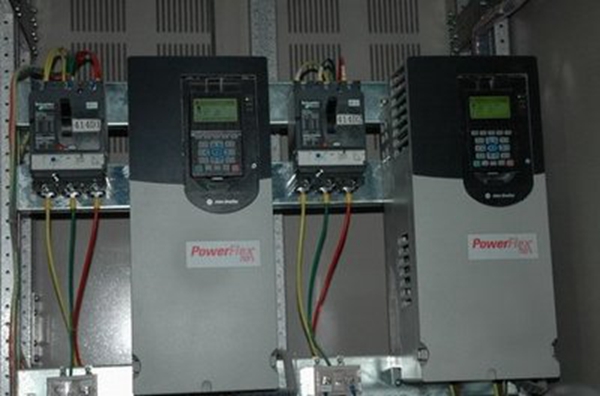
Frequency converter is a power control device that uses frequency conversion technology and microelectronics technology to control AC motors by changing the frequency of the motor's working power supply. The frequency converter mainly consists of rectifier (AC to DC), filter, inverter (DC to AC), braking unit, driving unit, detection unit, microprocessor unit, etc.
1. Main circuit
The main circuit is the power conversion part that provides voltage regulation and frequency regulation power for asynchronous motors. The main circuit of frequency converters can be generally divided into two types: voltage type frequency converters convert the DC of the voltage source into AC, and the filtering of the DC circuit is capacitors. Current type is a frequency converter that converts the DC of the current source into AC, and its DC circuit filtering is inductance. It consists of three parts: a "rectifier" that converts power frequency power into DC power, a "smoothing circuit" that absorbs voltage fluctuations generated by converters and inverters, and an inverter that converts DC power into AC power.
2. Rectifier
A large number of diodes are used as inverters, which convert power frequency power into DC power. Two sets of transistor converters can also be used to form a reversible converter, which can undergo regenerative operation due to its reversible power direction.
3. Smoothing circuit
In the rectified DC voltage of the rectifier, there is a pulsating voltage of 6 times the frequency of the power supply, and the pulsating current generated by the inverter also causes changes in the DC voltage. To suppress voltage fluctuations, inductors and capacitors are used to absorb fluctuating voltage (current). When the device capacity is small, if there is margin in the components composed of the power supply and main circuit, a simple flat wave circuit can be used instead of inductance.
4. Inverter
Contrary to rectifiers, inverters convert DC power into AC power at the required frequency, allowing six switching devices to turn on and off for a predetermined time to obtain a 3-phase AC output. Taking a voltage source PWM inverter as an example, the switching time and voltage waveform are shown.
5. Control circuit
The control circuit is a circuit that provides control signals to the main circuit that supplies power to an asynchronous motor (with adjustable voltage and frequency). It consists of a "calculation circuit" for frequency and voltage, a "voltage and current detection circuit" for the main circuit, a "speed detection circuit" for the motor, a "drive circuit" that amplifies the control signal of the calculation circuit, and a "protection circuit" for the inverter and motor.
(1) Operational circuit: Compare external speed, torque and other instructions with the current and voltage signals of the detection circuit to determine the output voltage and frequency of the inverter.
(2) Voltage and current detection circuit: isolated from the main circuit potential to detect voltage, current, etc.
(3) Drive circuit: The circuit that drives the main circuit components. It is isolated from the control circuit to make the main circuit components turn on and off.
(4) Speed detection circuit: The signal from the speed detectors (tg, plg, etc.) installed on the asynchronous motor shaft machine is used as the speed signal, which is fed into the calculation circuit. According to the instructions and calculations, the motor can operate at the commanded speed.
(5) Protection circuit: Detect the voltage, current, etc. of the main circuit. In case of overload or overvoltage, in order to prevent damage to the inverter and asynchronous motor.
The frequency converter adjusts the voltage and frequency of the output power supply by breaking the internal IGBT, providing the required power voltage according to the actual needs of the motor, thereby achieving energy conservation and speed regulation. In addition, the frequency converter also has many protection functions, such as overcurrent, overvoltage, overload protection, and so on. With the continuous improvement of industrial automation, frequency converters have also been widely used.
What are the main functions and working conditions of shaft parts processing
High speed cutting in precision parts machining
Related Article

Let us go over the foundations of the electroplating procedure. Electroplating involves several phases, and from pre-treatment to post-treatment there are several really significant ones.
The basic principle of surface treatment of precision parts in CNC machining

Audio panels, electronic cigarette shells, nameplateLOG, watch shells, etc. are among the CNC processing of high surface texture needs components.
CNC machining aluminum alloy parts high-quality surface texture process explained in detail

Metallic finishing, sometimes known as metallic finishing, is the process of using several techniques to change the surface of an object in order to improve appearance and performance, such as corrosion resistance, discoloration resistance, chemical resistance, abrasion resistance, and hardness, modify electrical conductivity, remove burrs, or apply a specific color to a machined part.
Metal CNC finishing surface treatment process and its working principle
