
What are the differences in the process characteristics of Dongguan turning and milling composite processing between flat and three-dimensional surfaces
author: Hansheng Automation
2023-05-16
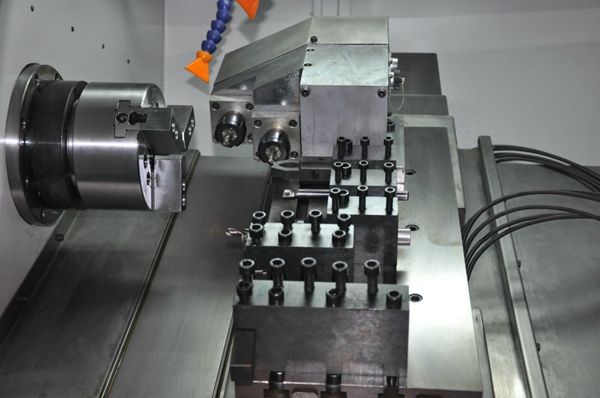
The plane processing of Dongguan turning and milling composite processing refers to the milling, drilling, reaming, boring, tapping and other processing processes of plane workpieces; 3D machining refers to the machining of 3D surfaces under the control of the interpolation function of the CNC system of the machining center. The specific processing objects include complex curved surface workpieces and irregular contour curved surface workpieces.
Characteristics of Plane Processing Technology for Turning and Milling Compound Machine
Compared with planar machining, the planar machining of machining centers is relatively simple in terms of machining difficulty and programming difficulty. Typical planar machining includes two types: cavity machining and contour machining.
Cavity machining is the processing of flat bottomed parts with closed boundary contours. It also includes cavity area machining and contour machining. Dongguan turning and milling composite processing generally uses end mills or forming cutters. From a step-by-step perspective, it is divided into two steps. The first step is to cut the inner cavity, mainly using two cutting routes. Whether it is circular cutting or row cutting, the common point is to ensure the entire cavity area. The cutting area should be clean, without leaving dead corners or damaging the contour. At the same time, efforts should be made to minimize the overlap of repeated passes. The second step is to cut the contour, which is usually divided into rough machining and precision machining. The tool path of the former is to offset the milling cutter radius inward from the contour of the cavity boundary and outward from the contour of the cutter, while the machining allowance of the latter is formed.
Characteristics of three-dimensional processing technology for turning and milling composite machines
With the continuous development of the industry, the demand for mechanical processing of complex surfaces and irregular parts is also increasing. These types of parts not only have to meet the standard for shape accuracy, but also have high requirements for their surface quality. Therefore, when processing such parts, the machining center used must have a three-dimensional positioning function.
The feed system of the turning and milling composite machine, due to its interpolation function in the CNC system, can perform multi axis linkage machining, thereby achieving three-dimensional curve positioning of the cutting tools. So, when encountering these complex parts, Dongguan turning and milling composite processing can be completed at a faster speed according to the program settings.
The Work Connection and Rationality of Precision Parts Processing
Two minutes to learn about the internal structure of Dongguan Turning and Milling Compound Processing Center
Related Article

Let us go over the foundations of the electroplating procedure. Electroplating involves several phases, and from pre-treatment to post-treatment there are several really significant ones.
The basic principle of surface treatment of precision parts in CNC machining

Audio panels, electronic cigarette shells, nameplateLOG, watch shells, etc. are among the CNC processing of high surface texture needs components.
CNC machining aluminum alloy parts high-quality surface texture process explained in detail

Metallic finishing, sometimes known as metallic finishing, is the process of using several techniques to change the surface of an object in order to improve appearance and performance, such as corrosion resistance, discoloration resistance, chemical resistance, abrasion resistance, and hardness, modify electrical conductivity, remove burrs, or apply a specific color to a machined part.
Metal CNC finishing surface treatment process and its working principle
