
How to program Dongguan turning and milling composite machining due to large surface roughness of the workpiece
author: Hansheng Automation
2023-05-16
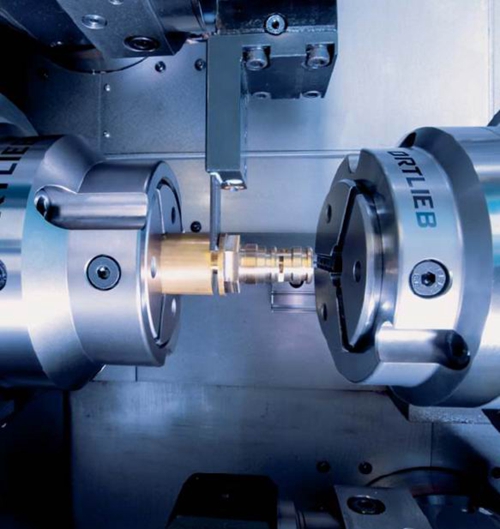
The areas with large concave and convex surfaces in Dongguan turning and milling composite processing are prone to interference between cutting tools and workpieces, resulting in serious consequences. The positioning 3+2 machining method can overcome the drawbacks of 3-axis CNC machining for complex surfaces. Turning milling composite positioning 3+2 machining refers to turning the B and C axes to a certain angle and locking them for processing. After the machining of one area is completed, adjust the B and C axes according to the normal vector direction of the other machining area to continue the machining angle.
Its essence is to change the five axis linkage machining to fixed angle machining in a certain direction. The direction of the tool axis no longer changes during the machining process. Due to the ability to achieve one-time machining, 3+2 positioning machining has significant advantages in efficiency and quality compared to 3-axis CNC machining. Turn-milling composite multi-axis milling precision machining solution. Using the multi axis linkage machining method, complete the machining of multiple complex fragmented surfaces of the cylindrical part of a complex rotating part, and select the machining geometry, driving method, and related parameters.
In actual machining, the characteristics of the machine tool should be fully utilized to effectively control the changes in tool swing angle, so as to ensure a good match between displacement and swing angle and prevent overfitting. To reduce the sharpness of the tool swing angle at the corner of the part, the position of the transition tool should be appropriately increased when machining the corner of the part. This is also beneficial for the smooth operation of the machine tool, avoiding over cutting, and improving the surface quality of the Dongguan turning and milling composite machining of the parts.
What are the steps of CNC precision machining
What are indexable milling cutters in precision parts processing
Related Article

Let us go over the foundations of the electroplating procedure. Electroplating involves several phases, and from pre-treatment to post-treatment there are several really significant ones.
The basic principle of surface treatment of precision parts in CNC machining

Audio panels, electronic cigarette shells, nameplateLOG, watch shells, etc. are among the CNC processing of high surface texture needs components.
CNC machining aluminum alloy parts high-quality surface texture process explained in detail

Metallic finishing, sometimes known as metallic finishing, is the process of using several techniques to change the surface of an object in order to improve appearance and performance, such as corrosion resistance, discoloration resistance, chemical resistance, abrasion resistance, and hardness, modify electrical conductivity, remove burrs, or apply a specific color to a machined part.
Metal CNC finishing surface treatment process and its working principle
