
What are the characteristics of the four basic motion modes of Dongguan turning and milling composite machining machine tools
author: Hansheng Automation
2023-05-16
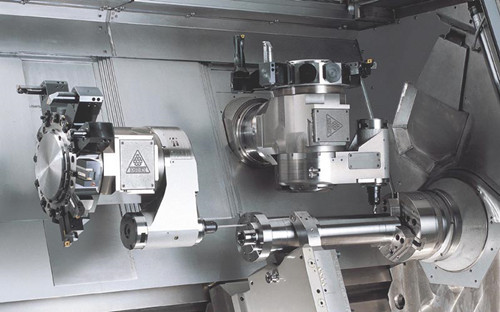
Dongguan turning and milling composite machining machine tool is the main type of composite machining machine tool. Usually, flat milling, drilling, slot milling, and other milling processes are achieved on CNC lathes. It has composite functions such as turning, milling, and boring. The processing concept of one-time clamping and full closing can be achieved.
It utilizes the composite motion of milling cutter rotation and workpiece rotation to achieve cutting processing of the workpiece, ensuring the shape accuracy, position accuracy, and surface integrity of the workpiece. Turning and milling combined machining is not simply a combination of the two machining methods on a single machine tool, but rather the use of turning and milling combined motion to complete various surface processing, which has emerged under the conditions of greater development of CNC technology today A new cutting theory and technology.
The motion of a turning milling composite machining machine tool includes four basic movements: milling cutter rotation, workpiece rotation, milling cutter axial feed, and radial feed. According to the relative position of the workpiece rotation axis and the tool rotation axis, turn-milling composite machining can be divided into axial turn-milling machining, orthogonal turn-milling machining, and general turn-milling machining. Among them, axial turning milling composite machining and orthogonal turning milling composite machining are the two most widely used turning milling composite machining methods. Axis turning and milling, as the rotation axis of the milling cutter is parallel to the workpiece, can not only process the outer cylindrical surface, but also the inner hole surface. Orthogonal turning and milling cannot process inner holes when the rotation axis of the milling cutter is perpendicular to the workpiece, and the inner hole diameter is small. However, when processing the outer cylindrical surface, the longitudinal stroke of the milling tool is not limited, and large longitudinal feed can be used. Therefore, Dongguan turning and milling composite processing has higher efficiency when processing the outer cylindrical surface.
Temperature is also an important factor for Dongguan turning and milling composite processing machine tools
What are the development types of milling machines in precision parts processing
Related Article

Let us go over the foundations of the electroplating procedure. Electroplating involves several phases, and from pre-treatment to post-treatment there are several really significant ones.
The basic principle of surface treatment of precision parts in CNC machining

Audio panels, electronic cigarette shells, nameplateLOG, watch shells, etc. are among the CNC processing of high surface texture needs components.
CNC machining aluminum alloy parts high-quality surface texture process explained in detail

Metallic finishing, sometimes known as metallic finishing, is the process of using several techniques to change the surface of an object in order to improve appearance and performance, such as corrosion resistance, discoloration resistance, chemical resistance, abrasion resistance, and hardness, modify electrical conductivity, remove burrs, or apply a specific color to a machined part.
Metal CNC finishing surface treatment process and its working principle
