
What types of cutting tools are used for turning and milling composite processing, and what are their characteristics
author: Hansheng Automation
2023-05-16
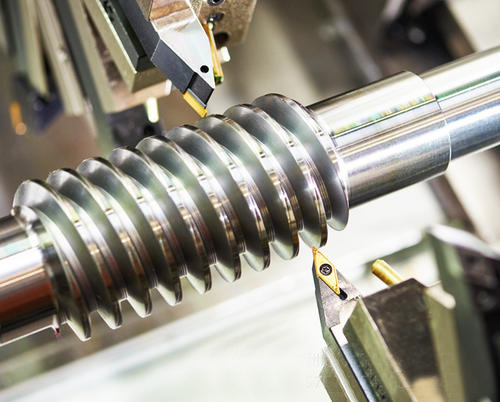
Turning milling composite machining has inherent processing advantages, so more and more people are choosing turning milling composite CNC lathes for machining. So what types of milling cutters are there for turning milling composite machining? Today, Hansheng Automation will explain to you the types and characteristics of milling composite cutters for a car.
1. End milling cutter
End milling cutter is a tool used for milling processing on a CNC milling machine. Similar to drill bits, they come in various sizes, types, and materials to choose from. If the end milling cutter is slotted, it means that the chips generated during the cutting process will accumulate in the space between the grooves during the cutting process. If you are cutting materials that produce large chips, such as aluminum, it makes sense to use end mills with fewer slots, which will have enough space to accommodate the volume of the chips. The two types of flute mills are 2-slot milling cutters and 4-slot milling cutters.
2-slot milling cutter
A 2-groove milling cutter with two grooves is used to form grooves or grooves. This type of rolling mill is also known as slot milling because it can be vertically driven into the workpiece. The cutting end of the drill bit has two blades of varying lengths. One directly passes through the middle, allowing the end mill to be directly inserted into the workpiece below it. A 2-slot milling cutter cannot be used in the same application as a 4-slot milling cutter.
4-slot milling cutter
A 4-slot milling cutter is used for flat milling and side milling, although this type of milling cutter can produce the same effect as a 2-slot milling cutter, such as making grooves and grooves.
Please remember that end mills with more grooves can machine smoother surfaces through turning and milling, but fewer grooves mean lower chip load, better chip cleaning, and less heat accumulation.
Want to improve the accuracy of turn-milling composite processing? Then remember these six points
These five points may be the main culprits that cause you to frequently collide with knives during turning and milling composite processing
Related Article

Let us go over the foundations of the electroplating procedure. Electroplating involves several phases, and from pre-treatment to post-treatment there are several really significant ones.
The basic principle of surface treatment of precision parts in CNC machining

Audio panels, electronic cigarette shells, nameplateLOG, watch shells, etc. are among the CNC processing of high surface texture needs components.
CNC machining aluminum alloy parts high-quality surface texture process explained in detail

Metallic finishing, sometimes known as metallic finishing, is the process of using several techniques to change the surface of an object in order to improve appearance and performance, such as corrosion resistance, discoloration resistance, chemical resistance, abrasion resistance, and hardness, modify electrical conductivity, remove burrs, or apply a specific color to a machined part.
Metal CNC finishing surface treatment process and its working principle
