
How to Reduce Errors and Ensure Processing Accuracy in Dongguan Turning and Milling Compound Processing under Limited Conditions
author: Hansheng Automation
2023-05-16
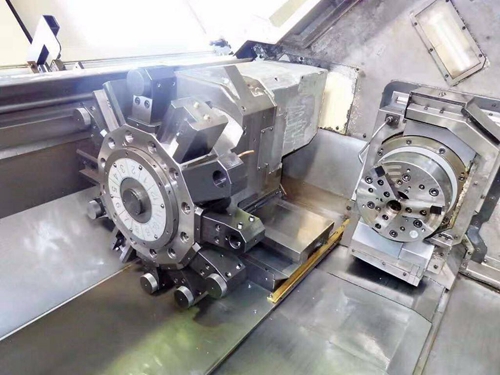
During the Dongguan turning and milling composite processing, the reduction in the number of fixtures avoids the accumulation of errors caused by positioning reference conversion. At the same time, most of the current turn-milling composite processing equipment has online detection functions, which can achieve in-situ detection and precise control of key data in the manufacturing process, thereby improving the processing accuracy of products; The high-strength integrated bed design increases the difficulty of gravity machining ability for cutting materials.
When turning and milling, the tool performs intermittent cutting, which can achieve relatively short cutting for any material formed workpiece and is easy to automatically remove chips. In addition, chip breaking can provide sufficient time for the tool to cool, reduce thermal deformation of the workpiece, and improve the tool's service life. Compared with traditional CNC machine tools, the turning speed of turn-milling composite processing is higher. Dongguan turn-milling composite processing has better product quality, reduced cutting force, improved machining accuracy of thin-walled and slender bars, and improved workpiece forming quality. High.
Due to the fact that cutting speed can be decomposed into the rotational speed of the workpiece and the rotational speed of the tool, according to mechanical characteristics, increasing and decreasing the rotational speed of the tool can achieve the same processing effect as the speed of the workpiece. Rough machining is particularly effective because reducing the speed of forging blanks can eliminate vibrations caused by workpiece eccentricity or periodic changes in radial cutting force, thereby ensuring smooth cutting of the workpiece and reducing errors.
When small turning and milling composite machine tools process workpieces, the low speed of the workpiece can effectively reduce the centrifugal force of the workpiece, avoid workpiece deformation, and improve the machining accuracy of the parts. In the process of turning and milling, larger longitudinal feed rates can also be used to obtain cutting, while effectively ensuring surface roughness. It can also clamp the workpiece in one go to complete multiple machining tasks, ensuring the accuracy of Dongguan turning and milling composite machining.
Specification for positioning methods and wear patterns of positioning components in precision parts processing
What are the application prospects and development trends of Dongguan turning and milling composite processing technology
Related Article

Let us go over the foundations of the electroplating procedure. Electroplating involves several phases, and from pre-treatment to post-treatment there are several really significant ones.
The basic principle of surface treatment of precision parts in CNC machining

Audio panels, electronic cigarette shells, nameplateLOG, watch shells, etc. are among the CNC processing of high surface texture needs components.
CNC machining aluminum alloy parts high-quality surface texture process explained in detail

Metallic finishing, sometimes known as metallic finishing, is the process of using several techniques to change the surface of an object in order to improve appearance and performance, such as corrosion resistance, discoloration resistance, chemical resistance, abrasion resistance, and hardness, modify electrical conductivity, remove burrs, or apply a specific color to a machined part.
Metal CNC finishing surface treatment process and its working principle
