
5-axis CNC machining

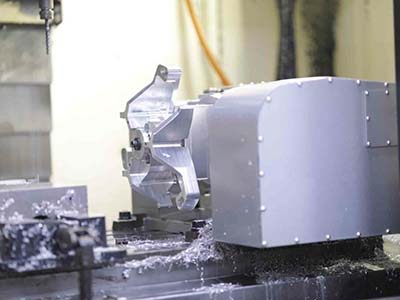
Five-axis CNC machine
What is five-axis CNC machining
5-axis CNC machining is a manufacturing process that utilizes CNC to control cutting equipment or different parts on five different axes at the same time. This increases the production capacity of complex parts and makes them widely used in various industries. Five-axis machining increases production proficiency and significantly reduces production time in the actual process. In addition, 5-axis machining can quickly approach the space with a rotating table or platform, avoiding collisions between the part clamping equipment and the tool. This also allows the cutting equipment to be kept in the optimal cutting position and consistent chip load, thus increasing the life or longevity of the equipment.
5 axes
5-Axis is the number of CNC machining modes, 5-axis adds 2 rotary axes to the three common linear axes of X, Y, and Z in 3-axis machining centers. Two of the three axes have different motion modes to meet a variety of technical requirements.
The main form of five-axis machine
Due to the different types of 5-axis machines, we can divide them into the following 5 types:
- In the form of double rotary head, the tool axis is controlled by two rotation coordinates.
- In the form of a droop rotary head, the two coordination axes are not perpendicular to the linear axis of the tool top.
- In the form of double rotary head, two coordinates control the space rotation.
- Droop table, the two axes are not perpendicular to the axis on the table.
- A pendulum and a rotation form, two rotation coordinates on the tool and the workpiece.
5-axis CNC machining is capable of manufacturing CNC parts with complex geometries, high tolerances, and excellent surfaces.
Types of five-axis machines
Five-axis CNC machines have different rotational axis arrangements to meet a variety of manufacturing requirements to save production time and enhance current procedures. There are 3 types, including head/head, table/table, table/header.
- Head/Head: This axis of rotation in a CNC machine is located in the head area, and all these 5-axis vertices are on a specific platform and move towards the workpiece holding platform. Due to the limited movement of the rotating axis and inclination, this makes this machine ideal for the production of large parts.
- Table/Head: In this machine, one axis of rotation is located on the table and the other at the head. The range of head rotary axes is limited, and the range of table rotary axes is unlimited. Since the workpiece is located on the axis of rotation, the machine is still limited to the production item number. While it has the advantage of consistency ability over the head/head type, there is no need to worry about the specific limitations of the direction of rotation.
- Table/Table: All rotary axes are located in the table, and the range of rotary axes is limited. But its rotation is not limited. Compared to other types, this type of machine has a minimum working range arrangement.
Many people mistake 5-sided machining for 5-axis machining. X, Y, Z, A&B 5 axes form 5-axis simultaneous machining, which is suitable for face hook, special-shaped, hollowing, punching, oblique hole and bevel cutting. Similar to 3-axis machining, 5-sided machining can only be processed on 5 sides, but special machining, bevel hole machining, and bevel cutting cannot be completed.
Advantages of 5-axis machining
Five-axis machining has the characteristics of high efficiency, high precision, and complementary clamping time. It is most suitable for modern molds as structural parts in various industries. Such as aerospace, scientific research, precision instruments, medical devices. It makes all spatial surfaces or unusual shapes in the most cost-effective way. Not only can it complete complex part tasks, but it can also improve process efficiency and reduce process flow.
Optimal cutting conditions
In the three-axis cutting process, the cutting efficiency gradually decreases once the tool moves towards the top or edge area of the workpiece. In order to get the best cutting conditions in the actual process, we need to rotate the table direction at different angles. For irregular planes, we have to rotate the platform several times in all directions. It is clear that 5-axis machining can produce better surface quality and avoid the low centerline speed of ball cutters.
Reduce processing time
5-axis CNC machining will reduce machining time compared to other types of operations. In most CNC centers, parts need to be machined on 5 sides separately. Whereas, 5-axis CNC milling allows for a quick and efficient machining process with just one setup. In the process of five-axis machining, the tool maintains the perpendicular state of the machined surface, reducing the machining time. It is also suitable for bevel side milling to eliminate ribbing caused by ball cutters. This will improve the surface quality of the part and reduce manual work.
Improve machining accuracy
Since extra settings lead to more errors, 5-axis machining with minimal settings will significantly improve accuracy. It also increases the service life of the cutting tool due to the shorter tool requirements. In 5-axis machining technology, the positioning of workpieces with complex angles on the platform will be solved, which will not only reduce the machining time, but also improve the machining tolerances. 5-axis machining can produce complex parts that cannot be manufactured by traditional methods, such as drilling, taper machining, cavities on various surfaces.
Superior surface finish
Since the 5-axis machine tool is closer to the workpiece, this will reduce tool vibration and result in a high quality finish
High production efficiency
5-axis machining reduces manufacturing time and auxiliary time, and the large spindle speed and feed range stimulate the machine to perform powerful cutting capabilities. Fast movement and positioning reduces turnaround time and increases ultimate efficiency and accuracy.
Disadvantages of 5-axis machining
Since 5-axis CNC machining technology plays an important role in the manufacturing and production industry, it is widely used in complex frustrations and complex surfaces. However, 5-axis machining is not widespread due to the following reasons.
High cost
The price of 5-axis machines and software is higher than that of ordinary machining centers. In addition, machine maintenance is more difficult. This will result in a 5-axis machined part costing more than a regular machine.
Complex and difficult programming
In the programming process, the spatial trajectory of the synthetic motion form is complex and abstract due to the involvement of two rotational motions, which is difficult to understand. In order to create a spatial freeform surface, we need to perform multiple coordinate transformations and complex spatial geometry operations during the programming process. In addition, the coordination of the various axes of motion should be considered to avoid interference and collisions. For higher machining accuracy and surface quality, programming is much more difficult.
The technical requirements are high
Since advanced technology requires higher talent to operate, 5-axis CNC machining requires highly skilled operators to move from single programming to machining operations.
DMG MORI Technology Cycle | Faster and more accurate measurements
The agency predicts that humanoid robots will usher in a breakthrough year this year, and China's robot industry chain is expected to benefit deeply
Related Article


