
Can Helical Gears Be Used at Any Angle
2025-06-17
Can Helical Gears Be Used at Any Angle?
In the realm of mechanical engineering, helical gears have long been revered for their smooth operation and efficient power - transmission capabilities. As industries strive for more versatile and adaptable mechanical systems, a common question arises: can helical gears be used at any angle? This blog post will embark on an in - depth exploration of this query, while also delving into the characteristics and applications of different types of helical gears, including plastic and metal helical gears.
Understanding Helical Gears: A Fundamental Overview
Definition and Basic Structure
Helical gears are cylindrical gears with teeth that are cut at an angle to the gear's axis. Unlike spur gears, whose teeth are straight and parallel to the axis, helical gears' angled teeth engage gradually as the gears rotate. This design feature significantly reduces impact loads and noise during operation, providing a smoother and more stable power - transfer mechanism. The angle at which the teeth are cut is known as the helix angle, which can vary depending on the specific requirements of the application.
Working Principles
The working principle of helical gears lies in the meshing of their angled teeth. When two helical gears mesh, the contact between the teeth begins at one end and gradually progresses across the entire tooth surface as the gears rotate. This gradual engagement distributes the load more evenly compared to spur gears, reducing stress concentrations and allowing for higher load - carrying capacities. The helical tooth design also generates an axial thrust force, which must be considered in the mechanical system's design and often requires the use of thrust bearings to counteract it.
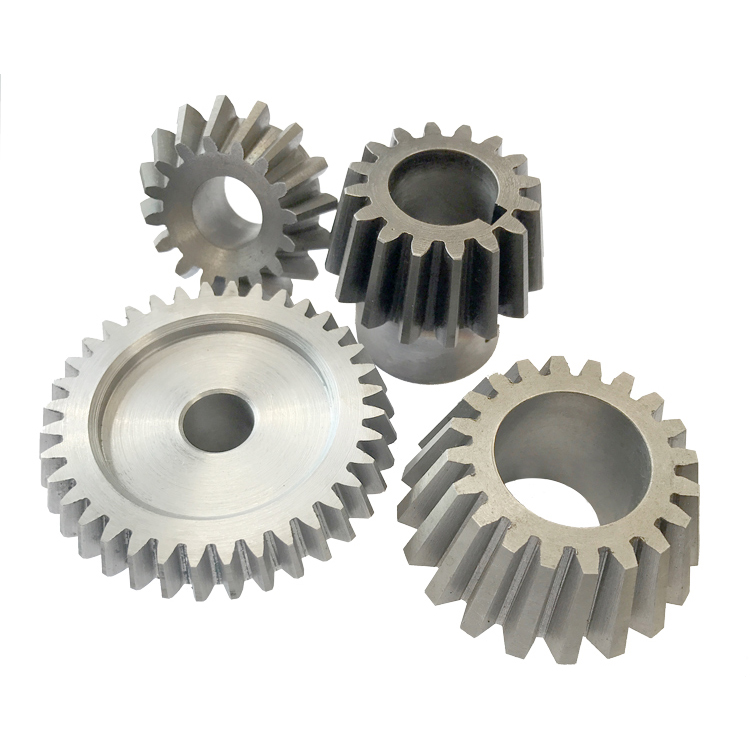
Can Helical Gears Be Used at Any Angle?
Theoretical Possibilities
In theory, helical gears can be used at various angles, not just limited to the traditional parallel - shaft arrangements. Helical gears can be employed in cross - shaft and intersecting - shaft applications. For cross - shaft applications, double - helical or herringbone gears can be used. Herringbone gears, which consist of two sets of helical teeth with opposite helix angles, cancel out the axial thrust forces generated by each individual helix, making them suitable for high - power applications where eliminating axial thrust is crucial. In intersecting - shaft applications, bevel - helical gears combine the features of bevel gears (for changing the direction of rotation between intersecting shafts) and helical gears (for smooth operation), enabling power transmission at different angles.
Practical Limitations
Despite the theoretical possibilities, there are practical limitations to using helical gears at any angle. One of the main constraints is the mechanical design and space limitations of the system. As the angle between the shafts becomes more extreme, it can be challenging to design a housing and support structure that can properly accommodate the gears and ensure proper meshing. Additionally, the manufacturing process of helical gears becomes more complex and costly when producing gears for non - standard angles. The precision required to cut the teeth at specific angles, especially for complex applications, increases the margin of error and manufacturing expenses. Moreover, the axial thrust forces generated by helical gears become more difficult to manage at certain angles, which may require additional components and more sophisticated engineering solutions.
Types of Helical Gears and Their Angular Adaptability
Plastic Helical Gears
Characteristics
Plastic helical gears offer several unique advantages. They are lightweight, which is beneficial in applications where minimizing weight is crucial, such as in consumer electronics and small - scale robotics. Plastic gears also have excellent corrosion resistance, making them suitable for use in environments where exposure to moisture or chemicals is common. Additionally, they produce less noise and vibration during operation compared to metal gears, enhancing the overall quietness of the mechanical system.
Angular Applications
Plastic helical gears can be used in a variety of angular applications, but their use is often limited by their lower load - carrying capacity compared to metal gears. In applications with relatively low torque requirements and gentle operating conditions, such as in the internal mechanisms of office equipment like printers and scanners, plastic helical gears can be effectively used at standard parallel - shaft angles. However, for more complex angular arrangements, such as cross - shaft or highly angled intersecting - shaft applications, plastic gears may struggle to handle the loads and forces involved. The lower strength and durability of plastic materials mean that they are more prone to wear and deformation under high - stress or high - angle operation scenarios.
Metal Helical Gears
Characteristics
Metal helical gears, typically made from materials like steel, stainless steel, or aluminum alloys, are known for their high strength, durability, and ability to handle heavy loads. They can withstand high torque, high - speed operation, and harsh environmental conditions, making them ideal for industrial applications. Metal gears also offer better precision and can be manufactured to tighter tolerances, ensuring accurate meshing and reliable performance.
Angular Applications
Metal helical gears have a broader range of angular adaptability compared to plastic gears. In industrial machinery, such as large - scale manufacturing equipment, metal helical gears are commonly used in both parallel - shaft and non - standard angular applications. For example, in power plants, metal helical gears can be found in gearboxes that transfer power between shafts at various angles, enabling the efficient operation of turbines and generators. In automotive transmissions, metal helical gears play a vital role in handling the high torques and complex angular arrangements required for smooth gear shifting and power distribution. Their ability to manage axial thrust forces and withstand heavy loads makes them suitable for a wide variety of angular configurations, although careful engineering and design are still required to optimize their performance at different angles.
Future Trends in Helical Gear Applications
As technology continues to advance, there is ongoing research and development aimed at expanding the angular capabilities of helical gears. New manufacturing techniques, such as 3D printing, are being explored to create custom - designed helical gears for specific angular applications with greater ease and precision. Additionally, the development of advanced materials, both for plastic and metal gears, may improve their performance at different angles. For example, new composite materials could enhance the strength and durability of plastic gears, allowing them to be used in more angularly challenging applications. In the case of metal gears, advanced heat - treatment processes and alloy compositions may further optimize their ability to handle high - angle operation and complex loading conditions.
In conclusion, while helical gears offer more angular flexibility compared to some other types of gears, they cannot be used at just any angle without considering practical limitations. The type of helical gear, whether plastic or metal, also significantly influences its angular adaptability. Understanding these aspects is crucial for engineers and designers when selecting and implementing helical gears in mechanical systems. As technology progresses, the boundaries of helical gear applications at different angles are likely to be pushed further, opening up new possibilities for more efficient and versatile mechanical designs.
这篇博客全面分析了斜齿轮的角度使用问题。若你想对某部分内容,如特定应用案例、材料特性等进一步展开,欢迎随时告知。
What is a Helical Gear
What Are Bevel Gears Used For
Related Article

Gears are the backbone of mechanical transmission systems, converting rotational motion and torque between shafts to power everything from household appliances to industrial machinery.
What are the 4 types of gears

CNC machines (Computer Numerical Control machines) have transformed manufacturing by delivering unmatched precision, repeatability, and efficiency across material types—from metals to plastics and composites.
Which Industries Mostly Use CNC Machines

CNC machining is celebrated for its precision and versatility in shaping metals, plastics, and composites—but its subtractive nature (removing material from a solid workpiece to create parts) raises a critical question: “Is CNC machining wasteful?” At first glance, the piles of metal shavings, plastic chips, and scrapped parts from CNC operations might suggest yes.
Is CNC machining wasteful
