
The price of collaborative robots is skyrocketing, and this robot company only costs around 20000 yuan!
author: Hansheng Automation
2023-05-20
Fao Yiwei
Under the policy directive of "Robot+", how to implement it tests the wisdom of every robot enterprise.
Fao Yiwei Robotics believes that in order for collaborative robots to truly become popular, the correct answer should be to strive towards making collaborative robots a highly cost-effective basic tool.
Welcome the "Spring" of Robots
A clear trend is that the robotics industry is ushering in new development opportunities, and the "spring" of robotics has arrived.
For example, in industrial scenarios, collaborative robots can complete tasks such as welding, palletizing, loading and unloading, riveting, handling, screw locking, spraying, gluing, polishing, laser engraving, laser printing, etc;
For example, in commercial scenarios, collaborative robots are engaged in activities such as coffee making, milk tea making, ice cream making, noodle cooking, pancake fruit making, accompanying practice (Go), self charging, music performance, photography, etc;
For example, in the healthcare industry, collaborative robots can also perform moxibustion, rehabilitation exercises, massage, surgery (cardiovascular surgery, skeletal surgery), etc;
For example, in the education and research industry, applications for educational equipment, teaching aids, and laboratories are also quite common, and some have been purchased by enthusiasts and geeks for secondary development, among others.
It can be said that the current application scenarios of robots are already very extensive, and a new wave of industry transformation is being sparked with a trend of blooming flowers. However, the problem is that for 90% of small and medium-sized enterprises in China, robots can easily be priced at tens of thousands or even hundreds of thousands, which is still a considerable amount.
This also leads to the current surge in the trend of robot+, but many business owners still prefer to use traditional manual labor or transfer industries to Southeast Asia, where the industrial chain is gradually forming, rather than carrying out automation reform of production lines, considering comprehensive costs.
Issues such as these will inevitably cause difficulties for many manufacturing entrepreneurs and management personnel who introduce automation equipment, and will directly affect the speed of the deepening of "robot+".
How to solve such conflicts? We have found that as a pioneer in collaborative robotics since its inception, Fao Yiwei is driving industry change through its own methods.
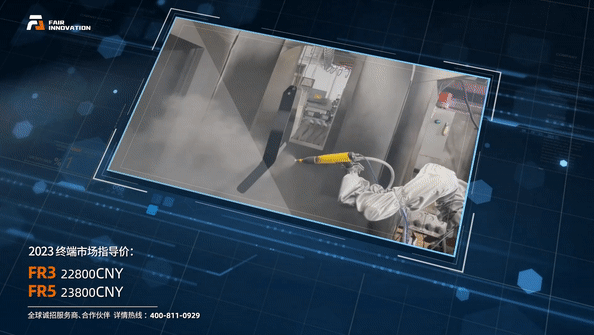
On March 10th, we saw that Fao Yiwei announced the new FR3 and FR5 collaboration robots at the 2023 terminal price press conference, and announced the industry's ultimate terminal market guidance prices -22800 and 23800 yuan.
It is worth mentioning that in the key parameter section, the FR3 collaborative robot has a load of 3kg, an arm span of 622mm, and a repeated positioning accuracy of ± 0.02mm; The FR5 collaborative robot has a load of 5kg, an arm span of 922mm, and a repeated positioning accuracy of ± 0.02mm.
In the context of the era of robot+, this ultimate cost-effective product may promote the rapid introduction of intelligent innovation achievements in robots into various industries, achieve further cost reduction and efficiency increase, and deeply integrate the new economic form of "robot+" into various fields of the economy and society.
The original intention of ultimate cost-effectiveness
The reason for such an extreme selling price may start with the founding intention of the Fao Yiwei team.
In the increasingly fierce competition in the manufacturing market, while conducting research on the design of two products, FAO Yiwei Robotics visited a large number of enterprises and discovered the transformation challenges that the current manufacturing industry still faces.
At present, in many traditional manufacturing fields, 80% of enterprises have not been exposed to collaborative robots or have used robots before. However, due to various reasons, the effectiveness of using robots is not satisfactory, resulting in a negative view of robots.
In the decades of development in the robotics industry, this was not an accidental event.
For some large enterprises, the deployment time of traditional industrial robots is too long, programming is too complex, and they rely heavily on professional technical personnel. In some small and medium-sized enterprises, due to the limited production area of the factory, it is difficult to meet the requirements for isolated areas.
Moreover, especially in small and medium-sized enterprises, current product manufacturing has become more efficient, with a high degree of non standardization, and multi batch and small batch production methods are more common. This requires robots to be more flexible and easy to deploy in order to solve the legacy challenges in cognition and application in these industries.
If we calculate based on labor costs, it is currently in line with the expectations of business owners for robots that a collaborative robot can replace the same proportion of labor within the same time frame. Therefore, the estimated selling price is exactly similar to the current price of the Fao Yiwei robot.
From this, it can be inferred that rigorous market research and analysis may also be an important reason for the initial creation of two ultimate cost-effective products by FAO Yiwei Robotics.
But in the years of development in the robotics industry, many companies have been striving to balance price and performance. Extreme prices are inherently difficult, let alone being able to collaborate with people and deploy flexibly, thereby truly reducing the heavy labor burden on workers on various production lines.
In the current situation of equal demand for collaborative robots both domestically and internationally, it is a difficult proposition for many enterprises to think about how to achieve compatibility and balance, as robots not only have a real development foundation, but also have advantages in terms of price.
However, due to Fa Ao Yiwei's insistence on "making a collaborative robot that can be used from industry to business to home" and continuous exploration on the arduous path of independent research and development as well as continuous technological changes, Fa Ao Yiwei's team of technical personnel has rapidly expanded and accounted for 70% of the entire company's employees during several years of development.
Thanks to strong research and development efforts, FAO Yiwei has finally found an answer in the localization of core components.
We have learned that as a collaborative robot company that prioritizes the independent research and development of all core components in China, FAO Yiwei has delved into chip level research and innovative supply chain models, quickly possessing the research and development and manufacturing capabilities of robot controllers, precision reducers, servo systems, and other core components and complete machine systems, truly realizing the entire industry chain ecosystem and finding its own answer in terms of price.
At present, based on the path of independent research and development of all core components, FAO Yiwei has gone further on the path of "robot toolization". Fao Yiwei hopes to continuously iterate technology and innovate supply chain models, continuously reduce the price and technical barriers for enterprises to use robots, and truly integrate collaborative robots into production and daily life.
We can see that the two robots released this time not only have unconventional prices, but also have various performance characteristics such as light weight, moderate load, and security, modularity, easy deployment, and quick adoption. There are many application scenarios that can be imagined.
For example, in terms of helping end application customers, this robot is more likely to meet the goal of reducing costs and increasing efficiency for enterprises. This type of robot can not only solve the possibility and security issues of human-machine cooperation in narrow spaces, but also adapt to the changing needs of production line updates and adjustments, and can easily get started to solve difficult problems in practical application scenarios.
Basic tools are the future of robots
This extreme price is not surprising for the current robotics industry. The huge market space for collaborative robots in the future lies in two foundations.
On the one hand, it benefits from policies and the market. The current "robot+" policy has actually put forward a clear demand for higher cost-effectiveness and easier to use robots, which requires products with higher cost-effectiveness to adapt to the needs of economic and social digital development, quickly innovate products and promote scenarios, and expand the depth and breadth of application.
On the other hand, it is only when collaborative robots truly enter life that they are expected to usher in a market of billions or even trillions, unleashing the greater potential of this category.
As an upgraded category, collaborative robots, with the focus on "replacing humans to achieve a better future life", will have a broader development space. Only by creating basic tools for robots can they better serve human production and life.
In order to make robots affordable in various industries, many manufacturers are still working hard. This also makes it possible that the collaborative robot prices proposed by Fa Ao Yiwei may not be the end point of the industry.
We believe that in the next few years, collaborative robots will be clearly divided into two routes: one is to move towards industrial categories through industrial collaboration, and the other is the continuous downward trend in prices. Perhaps in 2024, the price of robots may once again experience a price adjustment.
But we believe that ultimately, under the spring breeze of "robot+" and the efforts of new robot forces such as FAO Yiwei, China will quickly achieve the popularization of robots and truly promote the automation and intelligent upgrading of the entire industry.
Jieka, Yuejiang, and Aibo have launched their IPO guidance, and who has become the first wave of collaborative robots?
Youao Robot: Only by implementing applications and truly solving industry problems can we usher in a new outbreak
Related Article

In order to create new products that are constantly emerging on the market, we use different methods to process various materials.
What is Molding Processing? We will introduce some representative molding processing methods

In the context of vehicle electrification and intelligence, human-computer interaction with consumer experience and intelligent control as the core has become an important development theme of intelligent cockpits. The on-board display is at the core of the intelligent cockpit, benefiting from the continuous development of the Internet of Vehicles and smart cars, the on-board display will usher in new development opportunities.
Lighting up new opportunities for automotive electronics - all at the 2025 Guangzhou International Automotive Intelligent Cockpit and Vehicle Display Technology Event

The 2025 Asia International Power Semiconductor, Materials and Equipment Technology Exhibition will focus on "Focusing on Cutting-edge Technology Breakthroughs and Empowering Industrial Innovation and Integration". It will be held on November 20-22, 2025 at Guangzhou Poly World Trade Center Expo!
Focus on the power semiconductor industry - APSME 2025 Asia International Power Semiconductor, Materials and Equipment Technology Exhibition will be held in Guangzhou

Lexey's multi-axis bus stepper drivers – 2DM3/2CL3-EC (open/closed-loop) dual-axis series and 4DM3/4CL3-EC (open/closed-loop) four-axis series are innovative technologies designed to solve the above problems and help your equipment to achieve efficient upgrades.
"Three provinces" drive: Leisai multi-axis bus stepping, opening a new chapter in the miniaturization and upgrading of precision equipment